
Product concept
Safety-focused UX · System exploration · Design thinking
Safety Unit emerged from a design thinking challenge centred on a real social problem: improving citizen safety in urban environments. Together with two peers, we approached the brief as an open-ended design problem, intentionally pushing beyond familiar solutions to explore new ways of addressing a complex and sensitive issue.
We began with exploratory research, combining interviews, surveys and field observations to understand not only patterns of insecurity, but the emotional and behavioural factors shaping how people experience safety in their daily lives. Rather than converging too early, we deliberately kept the problem space open, allowing insights to drive multiple directions before committing to a solution.
The process followed a design thinking approach, with a strong emphasis on problem framing, iterative ideation and concept validation. We continuously evaluated trade-offs between desirability, technical feasibility and real-world constraints, using low- and mid-fidelity prototypes to test assumptions and refine the direction before converging on a single system-level solution.
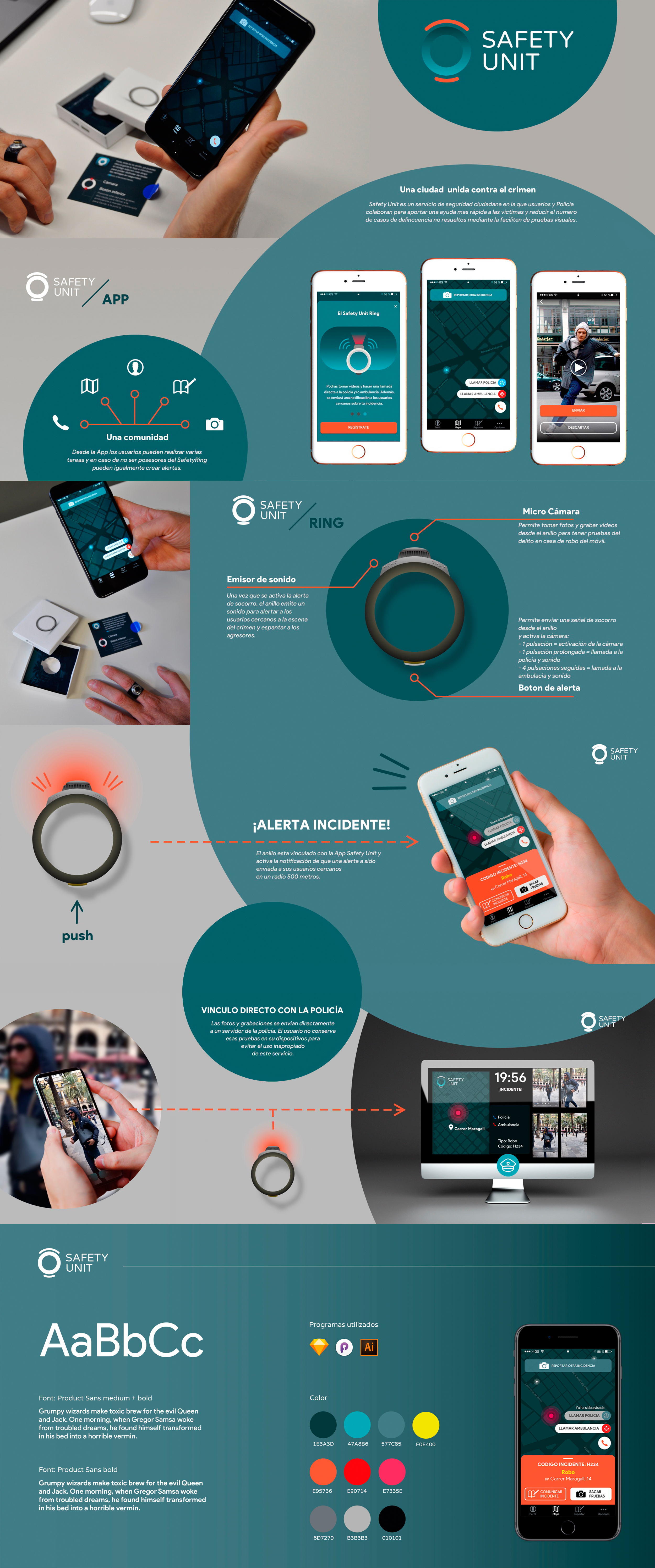
This process led us to conceive Safety Unit as a hybrid physical–digital system. The concept combines a connected wearable — a security ring — with a mobile application designed to enable fast, discreet interaction in critical situations. The ring was intentionally chosen as a non-intrusive and innovative form factor, offering immediacy without relying solely on smartphones or visible devices.
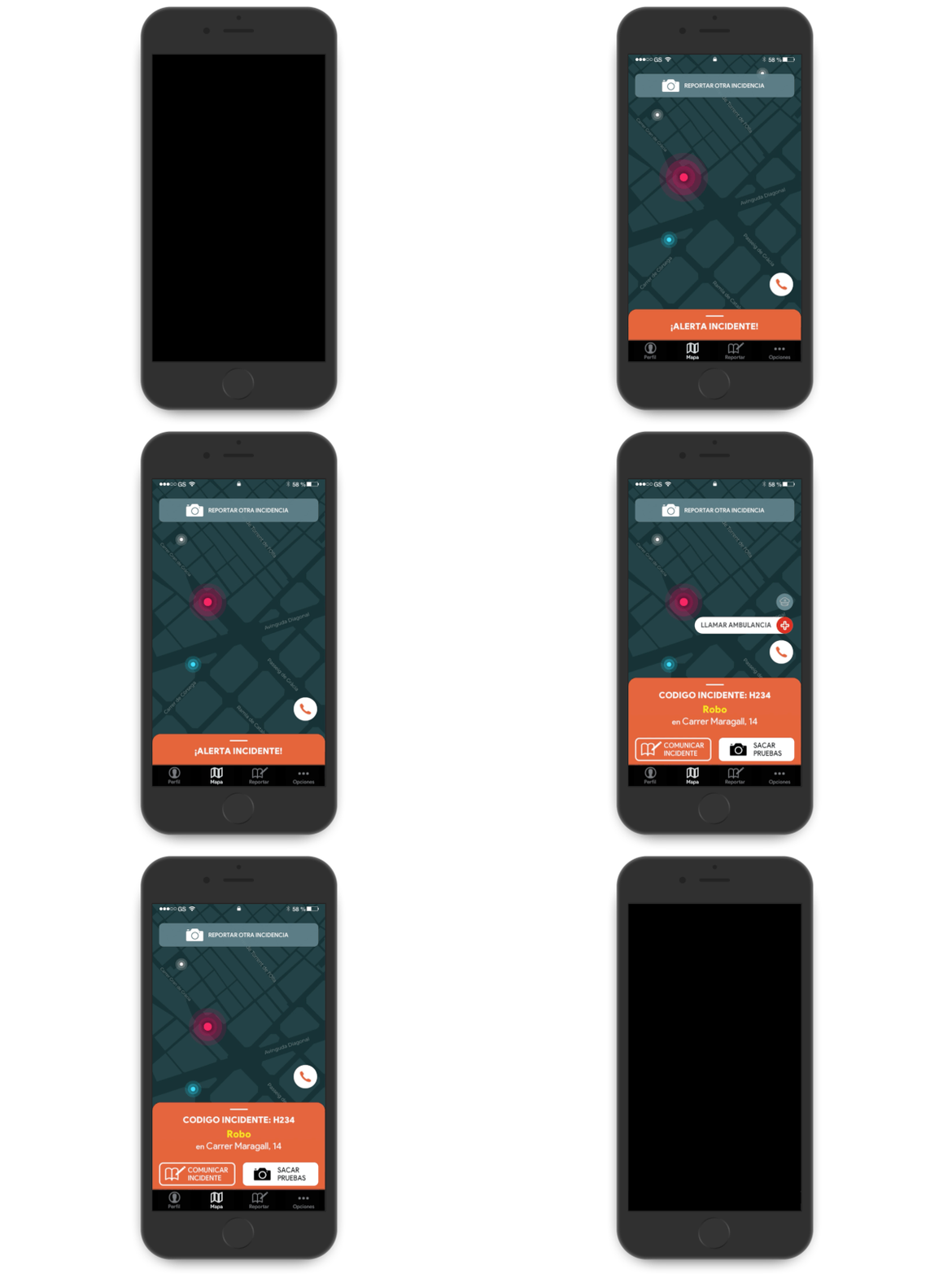
We explored interaction flows, system architecture and response scenarios with a strong focus on real-world use, clarity and reliability under stress. In parallel, we developed the product’s visual identity and interface language to communicate trust, urgency and agency, aligning functional requirements with emotional reassurance.
What defines this project is not only the final concept, but the decision-making approach behind it: resisting obvious answers, questioning assumptions and embracing uncertainty in order to reach a more ambitious solution. This experience shaped my interest in tackling complex problems through systems thinking and remains a reference point in how I approach design challenges today.
If you want to know more about the UX/UI process, read my article: Design Thinking: Improving Citizen Security. Part I.