
Context
Gender-based violence is a widespread and complex social issue that affects people across different ages, backgrounds and contexts. For many victims, accessing timely information, support services or emergency help can be difficult due to fear, stigma, lack of awareness or limited access to trusted resources.
Digital products can play a critical role in lowering these barriers by providing discreet, accessible and human-centred design approaches to support, especially in situations where asking for help openly is not possible. However, designing for safety in this context requires a careful balance between usability, emotional sensitivity and risk awareness.
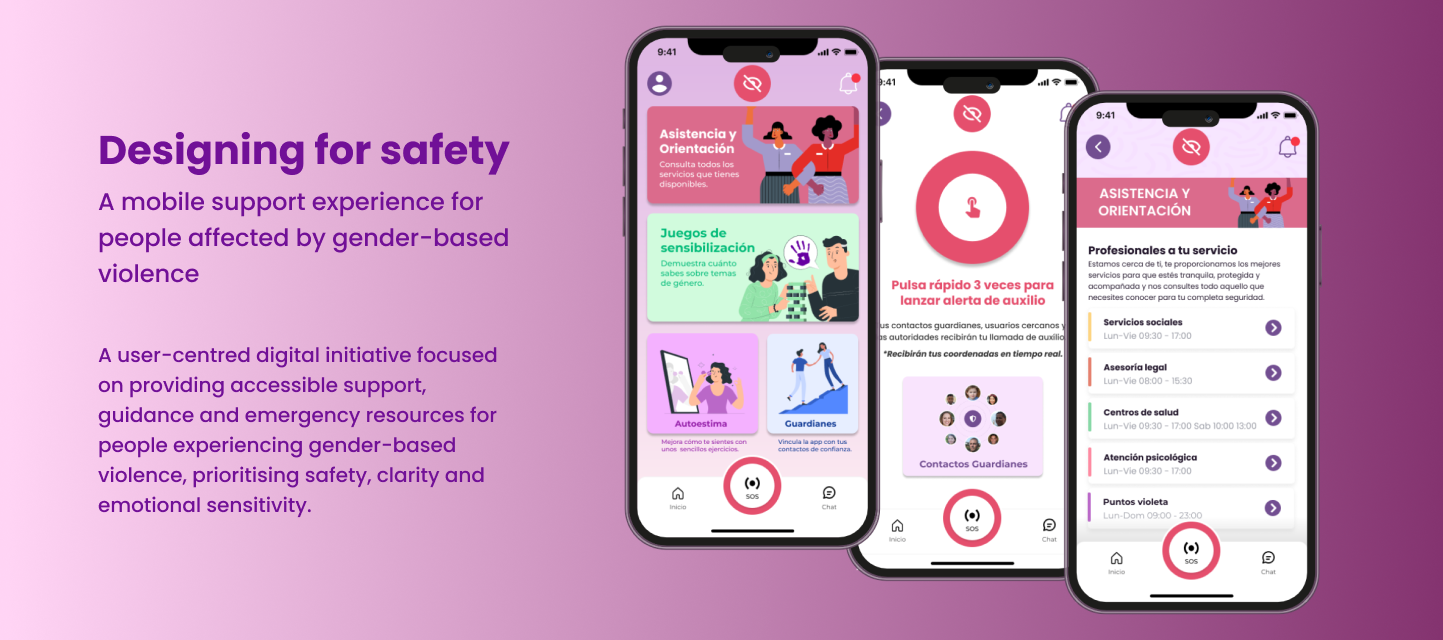
This project explores how a mobile experience could support people affected by gender-based violence by offering guidance, educational resources and emergency assistance, while prioritising user safety, privacy and control at every step.
Research approach
Due to the sensitive and high-risk nature of gender-based violence, the research phase prioritised ethical responsibility, user safety and emotional care over direct exposure to vulnerable individuals.
The approach combined qualitative desk analysis with indirect user methods to understand needs, behaviours and risks without increasing harm or retraumatisation, using behavioural indicators rather than direct exposure to sensitive scenarios.
Research techniques used
- Conducted desk research on gender-based violence, victim support models and crisis response frameworks
- Reviewed public guidelines from institutions, NGOs and support organisations
- Analysed existing digital safety and emergency support tools
- Ran exploratory interviews and anonymous surveys to gather qualitative insights
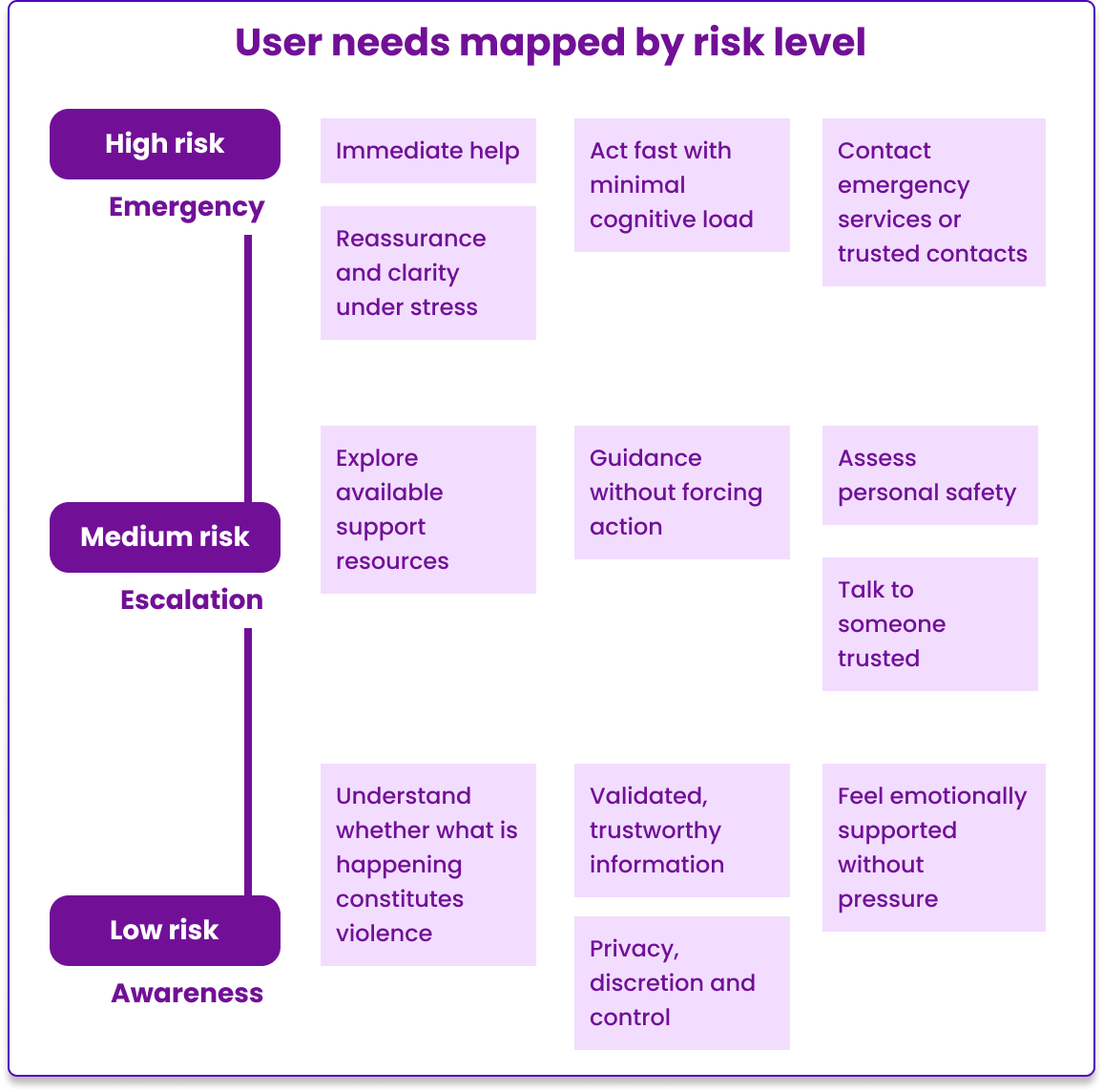
- Mapped user needs based on different levels of risk
- Applied heuristic evaluation focused on accessibility, emotional load and crisis usability
Design principles
Research insights informed a set of design principles to ensure safety, clarity and emotional sensitivity across different risk levels, while consciously managing decision friction and preserving user autonomy.
- Prioritise user safety over feature completeness
Ensure critical actions are accessible without exposing users to additional risk. - Reduce cognitive load in high-stress situations
Support fast decision-making through clear language, limited choices and progressive disclosure. - Respect privacy and user control at all times
Allow users to explore information and resources without forcing actions or disclosures. - Adapt guidance to different risk and urgency levels
Provide appropriate support depending on whether the situation is awareness, escalation or emergency. - Design with emotional sensitivity and non-judgemental tone
Avoid triggering language, visual pressure or assumptions about the user’s situation.
Strategy
Rather than designing isolated features, the strategy focused on structuring the experience around levels of risk and urgency, so that support, guidance and actions follow clear escalation paths aligned with users’ emotional and cognitive state.
The needs mapping informed a set of design principles that structured the experience around risk levels and progressive disclosure, allowing the experience to scale from awareness and guidance to emergency support without overwhelming or pressuring the user.
Strategic focus areas
- Prioritise user safety and control over feature density
- Adapt interaction patterns to cognitive load under stress
- Enable progressive disclosure based on risk level
- Avoid forced actions and irreversible decisions
- Ensure discretion, privacy and emotional sensitivity by default
Key design decisions
Based on the defined strategy and principles, a set of key design decisions shaped how the experience behaves across different risk and urgency levels.
Design decisions driven by risk
- Structured the experience into distinct informational, supportive and emergency paths to prevent accidental escalation and reduce unnecessary decision friction during early stages of orientation.
- Implemented a clear escalation model aligned with assessed risk and urgency levels to avoid premature transitions driven by anxiety rather than readiness.
- Exposed emergency actions as primary, low-effort interactions under high-stress conditions to reduce hesitation and reaction time in acute situations.
- Removed forced actions and irreversible decisions unless explicitly triggered by the user to minimise fear of consequences and support informed decision-making.
- Embedded discreet access, exit paths and privacy safeguards across the entire flow to reduce perceived risk of engagement and enable safe exploration at any point.
Core experience
The core experience was designed to respond dynamically to different risk levels, adjusting information density, interaction pacing and available actions according to the user’s context.
Awareness and guidance flow (low risk)
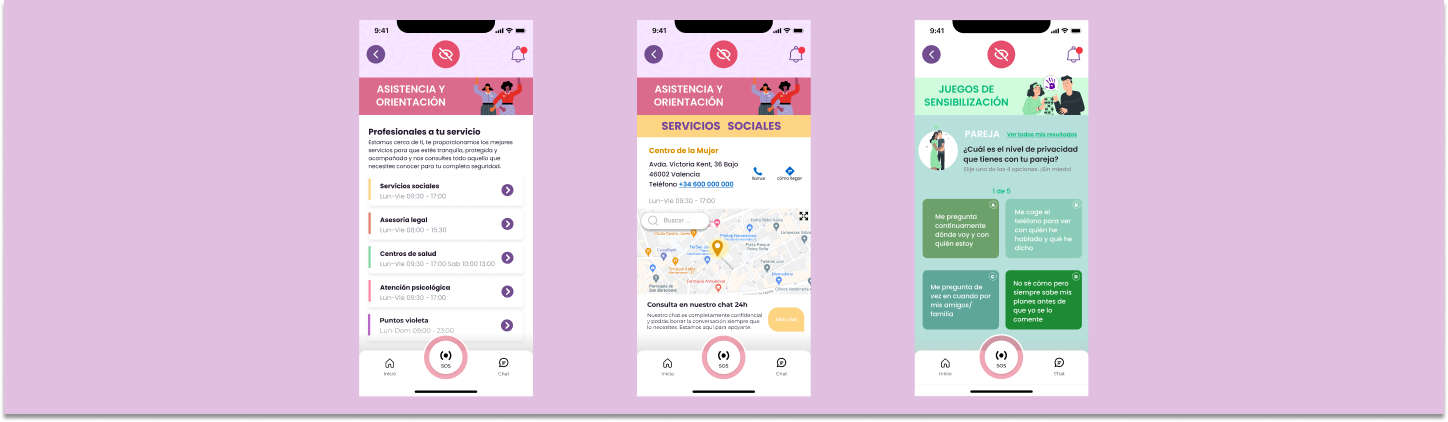
This flow supports early-stage exploration by presenting structured, non-intrusive information that users can navigate freely.
Navigation patterns were designed to minimise decision friction at early stages, allowing users to access verified resources, locations and educational content without committing to actions or triggering escalation paths.
Support and escalation flow (medium risk)
As risk increases, the experience introduces additional structure through guided steps and contextual prompts.
Decision-making is supported progressively, combining access to trusted resources with optional follow-up actions, while maintaining flexibility to pause, revisit information or disengage.
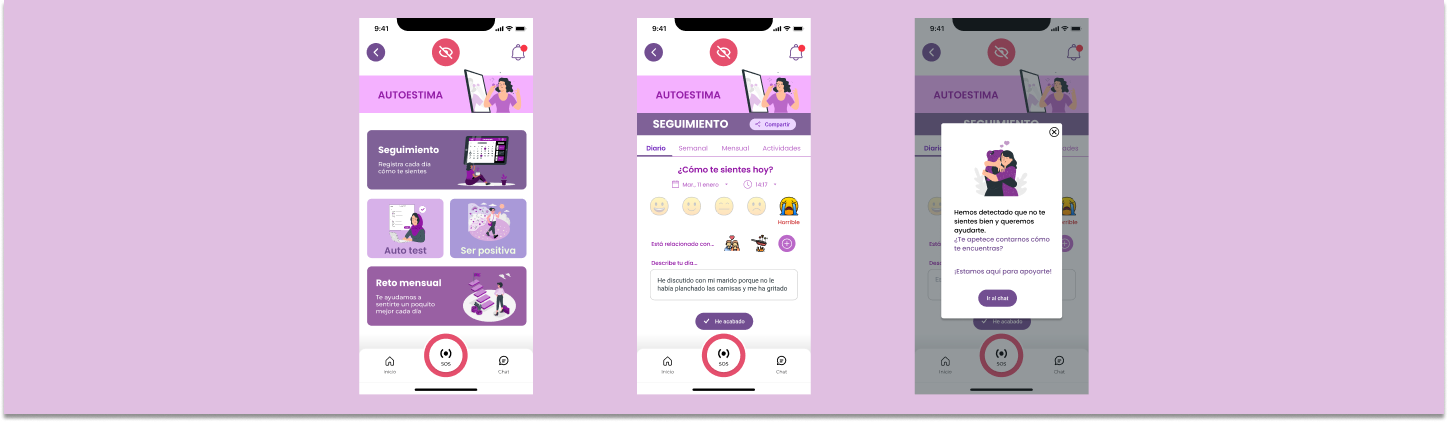
Emergency flow (high risk)
In high-risk situations, the interface shifts to a focused, action-oriented mode.
The experience prioritises direct access to critical actions, reduces on-screen complexity and shortens interaction paths to enable rapid response with minimal input.

Key flows overview
Rather than documenting every possible path, the experience was shaped around a limited set of key flows representing moments of highest emotional and cognitive demand.
- Awareness and guidance flow. Focused on exploration and understanding, enabling users to orient themselves without commitment or escalation.
- Support and escalation flow. Designed to structure decision-making over time, introducing guidance and options as confidence and readiness increase.
- Emergency flow. Optimised for speed and clarity, enabling immediate action through the shortest possible interaction paths.
Impact & outcomes
The project demonstrated how a safety-focused mobile experience could support users across different risk levels. Outcomes were evaluated through qualitative signals and behavioural indicators, reflecting changes in confidence, hesitation and decision-making patterns across awareness, support and emergency scenarios.
Key outcomes
- Improved clarity and confidence when accessing information and support resources.
- Reduced cognitive load in high-stress and emergency situations.
- Increased sense of control and autonomy across awareness, support and emergency flows.
- Clarified differentiation between guidance, escalation and emergency actions.
- Enabled safer access to support without forcing disclosure or premature escalation.
Success metrics
Given the sensitive nature of the product and existing constraints & limitations, success was primarily evaluated through qualitative outcomes and carefully selected behavioural indicators.
Evaluation indicators
- Completion rate of support flows by risk level
- Time required to access emergency actions
- Drop-off rate before escalation steps
- Usage of trusted contacts versus emergency services
- Self-reported sense of clarity, safety and confidence after interaction
Learnings & ethical considerations
Scope and constraints
The project was developed within legal, ethical and operational constraints that directly shaped both the scope of the solution and the design decisions taken.
These included limited access to end users in high-risk situations, dependency on public and third-party support services, and legal requirements around privacy, data handling and emergency escalation.
- Designing within these constraints required prioritising harm reduction over feature completeness and visual polish, accepting intentional limitations in functionality and interaction patterns.
- Indirect and anonymous research methods introduced limitations in depth and validation, but were necessary to avoid retraumatisation and reduce risk for participants.
- Structuring the experience by risk level required careful trade-offs between guidance and autonomy, balancing clarity with the need to avoid over-directing user decisions.
- This project highlighted the ethical limits of design in sensitive contexts, reinforcing that not all problems can—or should—be fully solved through interface decisions alone.
Let’s get in touch!
Feel free to reach out via email at paula.bernal.carro@gmail.com or connect with me on LinkedIn.